
What’s impressive to a songwriter might not be impressive to a record label, and vice versa. Therein lies the difference in artistic goals of the two sides of the music industry. Take, for example, Hitchhiker, an album by Neil Young that he wrote spontaneously, recorded under the full moon in the Malibu Canyon, and ultimately shelved for four decades after his record label decided it wasn’t fit for release.
In Jimmy McDonough’s Neil Young biography, Shakey, producer David Briggs described a songwriter at his creative peak. Described as “stunned” by watching Young work, Briggs recalled, “He’d turn to me and go, ‘Guess I’ll turn on the tap.’ And then out came ‘Powderfinger’, ‘Pocahontas’, ‘Out Of The Blue’, ‘Ride My Llama’. Two days, a day. I’m not talkin’ about sittin’ down with a pen and paper.”
Videos by American Songwriter
“I’m talkin’ about pickin’ up a guitar, sittin’ there and lookin’ me in the face, and in twenty minutes, ‘Pocahontas’,” Briggs continued. “No lyric sheet, no pen, no paper, none of that bulls***. Just ‘I picks up the guitar, and the demon takes control.’”
Neil Young’s Record Label Wasn’t Sold on ‘Hitchhiker’
Neil Young’s recording sessions for Hitchhiker were one of many that the singer-songwriter booked to coincide with the full moon. He recorded with producer David Briggs at Indigo Studios. And besides the copious amount of drugs in the studio, it was only Young and his guitar, a harmonica, and the occasional studio piano. “The idea I had at the time was to present these new songs in their purest and simplest form, just as they had been written,” Young later said.
Many of the songs Young recorded during that fateful full moon in 1976 became some of his most iconic. Two of the most notable are “Out Of The Blue” and “Powderfinger”. But at the time, Reprise wasn’t convinced that Hitchhiker was worthy of a full album release. The record label said the collection sounded more like a group of demos, sending Young back to the drawing board. Young would go on to release American Stars ‘n Bars instead, which he recorded four months after Hitchhiker.
The world wouldn’t see Hitchhiker as Young intended until four decades later, when Reprise finally released the album as part of Young’s archival release series. Even well after his peak of fame, Young’s album peaked at No. 20 on the Billboard 200. It broke into the Top 10 around the world. Of course, the question of how successful Hitchhiker would have been in the late 1970s is stuck in the “shoulda, coulda, woulda” annals of time.
Still, it’s a helpful reminder that record labels aren’t always right. And sometimes, the artist really does know best.
Photo by Larry Hulst/Michael Ochs Archives/Getty Images
More Behind the Album
-
Photo by Chris Walter/WireImage -

Photo by Ed Rode/Getty Images -
Photo by Murphy/Daily Herald/Mirrorpix via Getty Images -
Def Leppard on 8/23/81 in East Troy, Wi. (Photo by Paul Natkin/WireImage) -
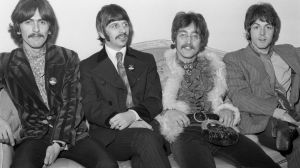
LONDON – MAY 19: (L-R) English musician, singer, songwriter and guitarist George Harrison (1943-2001), English musician, singer and drummer Ringo Starr, English singer, songwriter and guitarist John Lennon (1940-1980), and English singer, songwriter and bassist Paul McCartney of the Beatles attend a press party at the home of manager Brian Epstein supporting the release of Sgt. Pepper's Lonely Hearts Club Band, May 19, 1967 in London, United Kingdom. (Photo by Jeff Hochberg/Getty Images) -
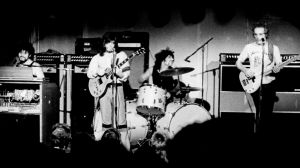
UNITED KINGDOM – JANUARY 01: MARQUEE Photo of VANILLA FUDGE, performing live onstage – L-R: Mark Stein, Vince Martell, Carmine Appice, Tim Bogert (Photo by Estate Of Keith Morris/Redferns) -
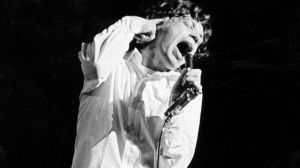
CIRCA 1966: Singer Mick Jagger of the rock and roll band "The Rolling Stones" performs onstage in circa 1966. (Photo by Michael Ochs Archives/Getty Images) -
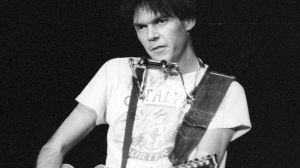
Musician Neil Young performing onstage in 1978 in Los Angeles. (Photo by Michael Ochs Archives/Getty Images)